2 Richmond Road
Planning application BH2025/03024
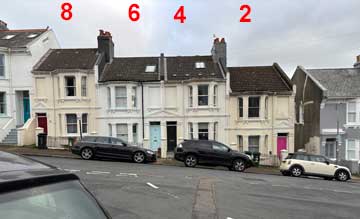
The planning committee supported the application: 7 votes FOR and 4 votes AGAINST. This gives permission for rear dormers, rear extension, front rooflight, window replacement (timber at front and uPVC at rear) and most controversially of all the creation of a new window in the recess occupied by the blind window above the porch at the front. The latter development, opposed by The Round Hill Society, will destroy the symmetry in architectural design of the terrace of four houses at 2 to 8 Richmond Road.
Built in 1897 by Burstow and Burstow, the terrace has remained intact, with the exception of some single rooflights, for almost 130 years. Arguing in favour of development the case officer presented several examples on separate terraces where she claimed that new windows looked worse than what was being proposed. The cats' creep was similarly downgraded by references to the amount of graffiti. The terrace from 2 to 8 Richmond Road has a special significance since it was added a couple of years before the Cats' Creep steps were constructed within space made available by the abandonment of Lennox Road. This was the arterial route shown in the 1853 plan of The Round Hill Estate which proved too steep for horse-drawn traffic.
The red (gabled terracotta-walled) house at 17 Round Hill Crescent at the foot of the Cats' Creep was also built in 1897 and also filled space vacated by Lennox Road. I was saddened to listen to parts of Round Hill being trashed in order to justify overdeveloping a good example of late Victorian architecture that has remained intact.
View comments on the Council's website.
View the agenda page 187 for the planning committee meeting on 4th March.
DESCRIPTION
Replacement of timber sash windows with uPVC double glazed heritage style sash windows, single storey rear extension, loft conversion with 2 rear dormers and 2 front conservation roof-lights, addition of a door at lower ground floor.
The applicant submitted revised plans on 20 January 2026 just one day before the period of public consultation ended. We have two main concerns regarding the impact of the proposal which remain unaddressed.
Read the UPDATED OBJECTION FROM THE ROUND HILL SOCIETY ON AMENDED PLANS
Objection 1
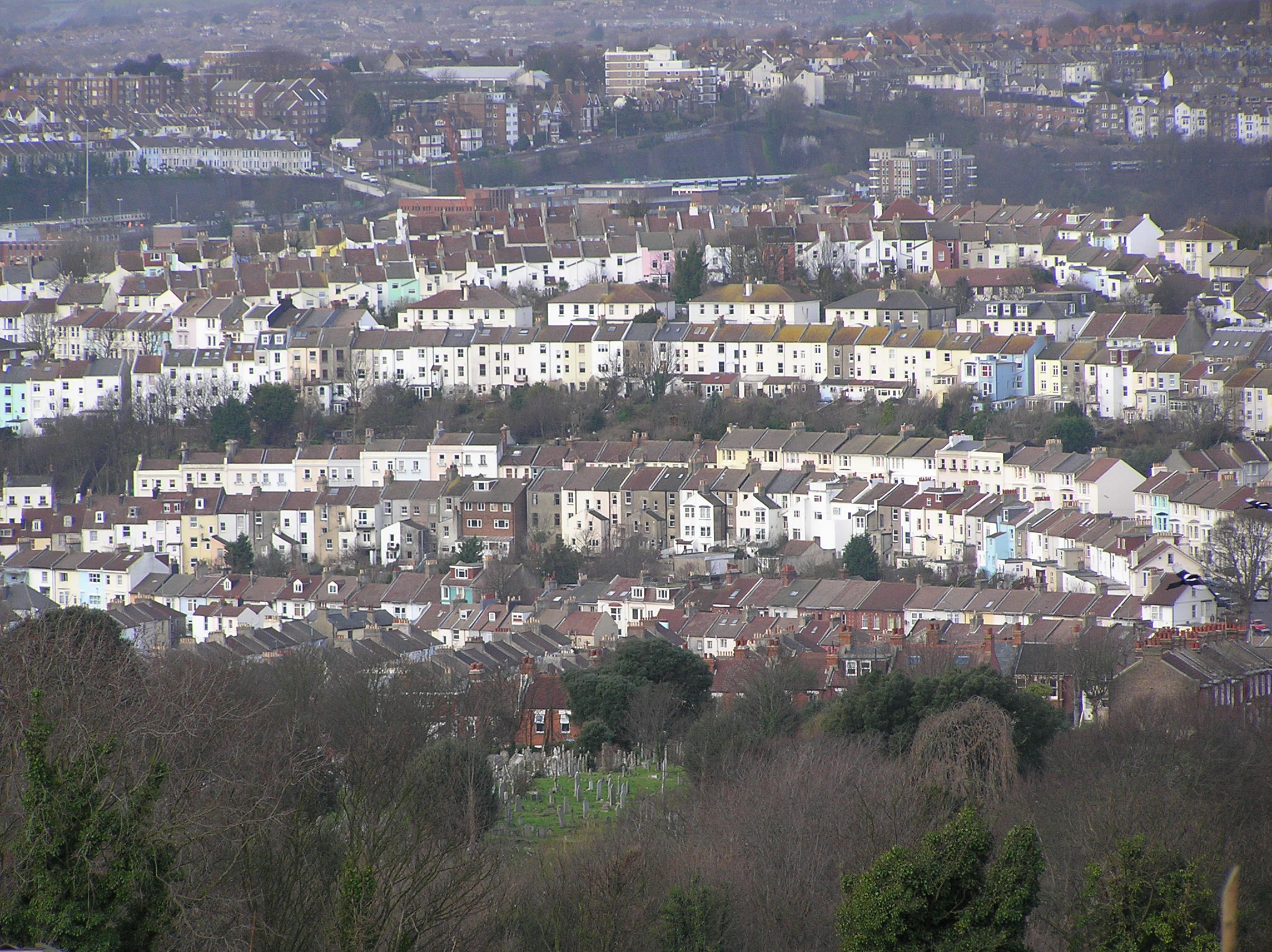
The terrace at 2–8 Richmond Road forms part of a long and largely intact run of late-Victorian housing extending along Richmond Road to No. 128, characterised by a predominantly uniform and unbroken rear roofline. There are no existing dormers in the terrace itself and very few beyond it.
Click here or on the picture above to enlarge.
[Opens in a separate window]
The green arc across the middle of the picture - Round Hill's best green ribbon - accentuates the continuity and rhythm of the terrace roofline, in front and behind, reinforcing the legibility of the historic roofscape and its contribution to the conservation area’s character.
Key points of context:
- Rear dormers are the exception rather than the norm along Richmond Road.
- Only five properties have rear dormers: Nos. 10, 68, 70, 76, and 86. The last of these approvals was in January 2007. Four of these are bunched together to the extreme right of the picture so they are peripheral to the main long view.
- These dormers are isolated interventions and do not establish a coherent or prevailing pattern of development.
As previously noted, “there does not yet exist a clearly established local pattern of dormers” and “the uniformity of the rear roofline has not yet been compromised.” The terrace at Nos. 2–8 clearly demonstrates this intact condition and continues to make a positive contribution to the character and appearance of the Round Hill Conservation Area.
A direct and highly relevant parallel exists with BH2021/00293 No. 94 Richmond Road, which was the most recent application for rear dormers on Richmond Road and was refused in March 2021. Key corner-house relationships include:
- No. 94 and No. 96 Richmond Road — forming a coherent roof composition at the end of the terrace.
- No. 2 Richmond Road and No. 29 Wakefield Road — similarly forming a coherent corner roof composition which is visible in long views into the Round Hill conservation area.
In each instance, the pitched roof forms act together as a unified architectural element, reinforcing the legibility and completeness of the terrace end.
In refusing the application at No. 94, the Council concluded that the proposed rear dormers and roof alterations would be “incongruous and unsympathetic additions to the roofscape” which would “unbalance and disrupt the continuity of the historic terrace”, causing harm to both the host building and the wider conservation area. The refusal highlighted the corner location and that the roof elevations were “highly visible in the public realm”, with existing roofs being “key architectural elements framing the end of the terrace”.
The same considerations apply with equal force at No. 2 Richmond Road. Introducing rear dormers here would:
- Disrupt the established roof relationship between No. 2 and No. 29 Wakefield Road clearly visible in long views into the CA.
- Fragment a roofscape that currently reads as a single, coherent form.
- Unbalance the terrace end and erode the continuity of the historic roofline.
This would be contrary to SPD12 guidance that “dormer windows will not be permitted where they would unbalance a building or disrupt the continuity of a terrace or group”.
The refusal at No. 94 confirms that the absence of dormers at terrace-ending corner houses is not incidental but a material and defensible planning consideration. Allowing the proposed dormers at No. 2 would be inconsistent with that decision and would undermine the purpose of the Article 4 Direction, which aims to prevent incremental erosion of historic roof forms.
Furthermore, the scale, form and grouping of the proposed dormers would dominate the rear roof slope and detract from the “largely unbroken roofscape” identified by the Council as contributing positively to the character of the Round Hill Conservation Area.
For these reasons, the proposal would fail to preserve the character and appearance of the conservation area and would conflict with Policies QD14 and HE6 of the Brighton & Hove Local Plan, CP15 of the City Plan Part One, and guidance set out in SPD12.
Dormer analysis - 4 out of 5 are bunched together. Apart from no.10 the roofline is flat from No.2 to No 66. Only a handful of approvals and only one which adversely affects the conservation area
The main issues are whether the proposal would preserve or enhance the character or appearance of the Roundhill Conservation Area.
Richmond Road (east) houses are numbered from 2 to 128
No.10 - approved in Sept 1996 - detracts from the long view
No.68 - approved in July 2001 - peripheral to main view
No.70 - approved in July 2004 - peripheral to main view
No.76 - approved in May 2003 - peripheral to main view
No.86 - approved in Jan 2007 - peripheral to main view.
No.94 - refused in March 2021- corner with Ashdown Road
Round Hill Crescent
No.57 BH2018/00555 - approved in April 2018
No.83 BH2016/06071 - refused in June 2017
Dismissed on appeal APP/Q1445/D/17/3180614 14th Dec 2017.
SPD12 Design Guide for Extensions and Alterations
QD14 Extensions and alterations
HE6 Development within or affecting the setting of conservation areas
CP15 Heritage
BH2021/00293 2no dormers to rear.
Objection 2
Objection to proposal to insert a new window into the ‘blind’ recess Harm to a heritage asset and the Round Hill Conservation Area. Note the triangular pediment above the porch, the cill supported by moulded brackets and the recessed blind window above that. There was a late Victorian revival of classical terrace architecture often described by historians as Italianate/ Neo-Renaissance / late stucco-terrace architecture.
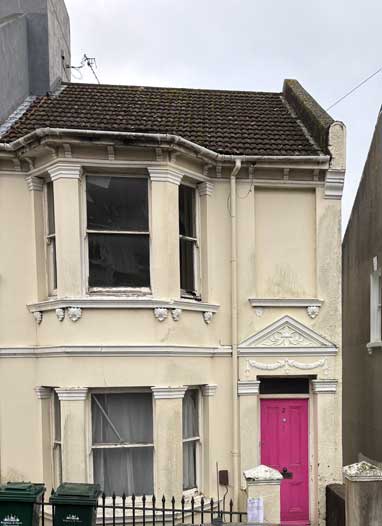
The proposal to insert a window into the blind recess above the doorway of No. 2 Richmond Road causes clear harm to the significance of a non-designated heritage asset within the Round Hill Conservation Area, contrary to City Plan Part One policy CP15 (Heritage) and City Plan Part Two policy DM28 (Conservation Areas). These policies require development to preserve or enhance the character and appearance of conservation areas and their constituent buildings.
Nos. 2–8 Richmond Road form a coherent and symmetrical 1897 terrace, designed as four matching houses with a carefully balanced composition: a central pair articulated by a shared doorway and pediment, flanked by end houses that provide visual balance, and each incorporating identical first-floor blind windows. The blind window at No. 2 is an intentional architectural device and an integral part of this unified design. Its alteration would erode the architectural logic of the terrace and undermine its historic integrity, in conflict with CP12 (Urban Design) and DM18 (High Quality Design and Places), which require development to respect the existing townscape, architectural rhythm and proportions of historic buildings.
Loss of architectural detail and townscape value
The front elevation, including the elaborate doorway and entablature, makes a strong positive contribution to the character and appearance of the conservation area. The proposed alteration would introduce an incongruous element that disrupts this elevation, contrary to SPD12: Design Guide and SPD09: Architectural Features, both of which emphasise the retention of original architectural features and warn against incremental changes that dilute historic design intent.
Unnecessary intervention
The additional window is not required to provide adequate daylight, as the room is already well lit by the existing bay window. The proposal therefore fails the policy test that harm to heritage assets must be clearly justified and necessary, as set out in CP15 and reinforced by the NPPF (paragraphs 199–202), which require great weight to be given to the conservation of heritage assets and make clear that unjustified harm should not be permitted.
Prominent location and wider setting
The terrace occupies a prominent corner at Richmond Road and Princes Crescent and sits at the head of The Cats Creep, a distinctive stepped walkway that is a valued feature of the conservation area, appreciated for its architectural enclosure and long eastward views towards Race Hill. The visual coherence of the terrace forms an important part of this setting. Harm to the symmetry and unity of the terrace therefore has wider townscape impacts, contrary to CP12, DM18 and DM28.
Mischaracterisation of the site context
The applicant’s references to graffiti and claims of a degraded setting are inaccurate. The Cats Creep is actively cared for by local residents and GoodGym volunteers, and retains a strong sense of place and architectural value. The assertion that the proposal would have minimal impact fails to properly assess the contribution the existing façade makes to the conservation area, contrary to CP15 and DM28.
Conclusion
By disrupting the symmetry, architectural coherence and historic character of this 1897 terrace, the proposal causes clear and unjustified harm to the Round Hill Conservation Area. In policy terms, this harm is significant and is not outweighed by any public benefit. This objection alone is sufficient to warrant refusal of the application.
CP12 Urban Design
CP15 Heritage
DM18 High Quality Design & Places
DM28 Locally Listed Heritage Assets
The proposed replacement Upvc windows will not accord with policy, which normally requires timber:
- Supplementary Planning Document 09- Architectural Features pages 28-34 give clear guidance and include reasons, e.g. sustainability, repairability and environmental impact.
- SPD12 Design Guide for Extensions and Alterations page 15
See also the article entitled Wood versus uPVC on this site.
The policy is clear that original or historic windows should be retained unless they are beyond economic repair. Where replacement is justified, new windows must match the originals in their design, proportions, method of opening, and external detailing. On street-facing elevations, original materials must also be matched, and aluminium or UPVC replacement windows are unlikely to be permitted where the original windows were timber.
The applicant provides no justification for the use of uPVC, compounded by the inaccurate drawings and limited details provided. If uPVC is pursued, full large-scale details should be provided to demonstrate slim meeting rails, appropriate profiles, and deep recessing within the reveals to avoid visually intrusive frames and potential harm to the character of the building and terrace.
Policy conflicts
Policy Conflict – Dormer and Blind Window Proposals
The proposed rear dormer and insertion of a window into the blind recess are contrary to the development plan and national policy.
Under SPD12: Design Guide for Extensions and Alterations, dormers must be subordinate to the roof, proportionate, well-spaced, and must not disrupt roofline rhythm. Rear dormers should be set down from the ridge and in from the sides so as not to appear dominant or “top heavy”. The proposed dormers fail these criteria and would disrupt the predominantly consistent roofscape identified in the Round Hill Conservation Area Character Statement, which highlights the importance of long views and the visual continuity of rooflines and green back gardens.
The proposal is therefore in conflict with:
- CP12 (Urban Design) – which requires development to respect local character, architectural rhythm and townscape quality.
- QD14 (Extensions and Alterations) – which resists extensions that fail to respect the design and character of the existing building or area.
- HE6 (Development Within or Affecting the Setting of a Conservation Area) – which requires development to preserve or enhance the character or appearance of the conservation area and resists proposals causing adverse impact.
- CP15 (Heritage) – which requires conservation and enhancement of heritage assets and gives great weight to their protection.
The opening up of the blind window similarly conflicts with policy. The blind recess forms part of the original 1897 symmetrical terrace composition and contributes to its architectural coherence. Its alteration erodes the historic design intent and harms the significance of the non-designated heritage asset and its conservation area setting, contrary to:
- CP12 (Urban Design)
- CP15 (Heritage)
- DM18 (High Quality Design and Places) – requiring contextual understanding and preservation of architectural coherence.
- DM28 (Conservation Areas) – requiring preservation or enhancement of character, appearance and important views.
- SPD09 (Architectural Features) – encouraging retention of original architectural details.
- The National Planning Policy Framework (NPPF, paragraphs 199–202) requires great weight to be given to conserving heritage assets and makes clear that harm must be clearly and convincingly justified. No such justification or public benefit has been demonstrated.
Taken together, the dormer and blind window proposals cause unjustified harm to the character, symmetry and roofscape of the terrace and to the wider conservation area. They therefore conflict with the development plan as a whole and should be refused.
This page was last updated by Ted on 05-Mar-2026