Fern Villa
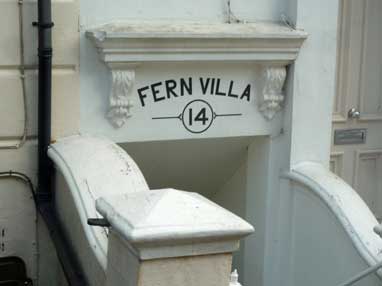
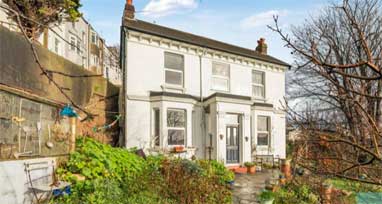
Fern Villa is a large detached two-storey cottage accessed via entrance steps and a passageway through 14 Wakefield Road and may date from c.1879.
Basic description
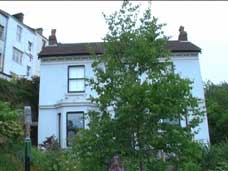
Fern Villa is a detached two-storey cottage dating from around c.1879.
It is not on the street frontage like most houses in Wakefield Road.
Instead, it sits to the rear of the terrace, accessed via a passageway through No. 14.
In other words, although associated with 14 Wakefield Road, it is effectively a backland or hidden house.
Setting and uniqueness
It stands alone on a strip of green land running behind Wakefield Road and neighbouring streets. This “green ribbon” is part of the Round Hill conservation area, valued for: long views across the valley.
open space within a dense Victorian suburb
Fern Villa is the only historic building on this strip, making it highly distinctive. Because of this, it is often described as “uniquely situated” within the area.
Relationship to Wakefield Road
Wakefield Road itself was largely developed 1877–1880 as a working-class terrace (mostly railway workers).
Fern Villa appears to be contemporary with this development, but: not part of the main terrace; likely built as a separate cottage or villa within the plots behind. This makes it a surviving fragment of a more varied Victorian landscape, before the area became densely terraced.
Later history and planning interest
Fern Villa has played a notable role in local planning debates: A 2011–2012 planning proposal sought to build a modern “earthship”-style house nearby. Residents strongly opposed it, arguing: Fern Villa should not set a precedent for further building; the green space is historically and visually important. The application was refused in 2012.
Since then, Fern Villa has often been cited as: a key heritage asset, and a test case in protecting backland green space in Round Hill.
Earlier references
A photograph labelled “14 Wakefield Road (now Fern Villa)” exists from 1929, indicating the name was in use by then. The site itself is recorded as developed circa 1879, consistent with late Victorian expansion.
Why it matters
Fern Villa is significant because it combines: Architectural interest: a surviving detached Victorian cottage; Urban form: a rare backland dwelling in Brighton; Landscape value: part of a protected green corridor; Planning importance: central to debates about conservation vs development.
In short
Fern Villa at 14 Wakefield Road is: a hidden Victorian cottage (c.1879); accessed through the terrace rather than from the street; uniquely positioned on protected green land; an important feature in the Round Hill conservation area.
Named residents & census context
Direct census entries for Fern Villa itself are tricky because: it sits behind No. 14, and earlier censuses often list it simply under Wakefield Road without a separate house name.
However, we do have one very useful early reference: 1929: A photograph captioned “14 Wakefield Road (now Fern Villa)” featuring Marion Reeve.
This tells us: the house was already known as Fern Villa by the late 1920s; it may previously have been treated simply as part of No. 14.
What about earlier (Victorian) residents?
For the 1891 census, Wakefield Road residents included: railway engine firemen, boiler makers, coach painters, railway porters.
This strongly suggests: the front houses were working-class railway households. Fern Villa, being detached and set back, may have had a different status (possibly: a small villa for a clerk, foreman, or tradesman or even tied to earlier land use)
This page was last updated by Ted on 11-Apr-2026