Ashdown Road
After reading this page, try the 19-question quiz
See also the Ashdown Road section on page 6 of the proposed update for Round Hill's conservation character statement:
You may also like to read about Ashdown Road Development
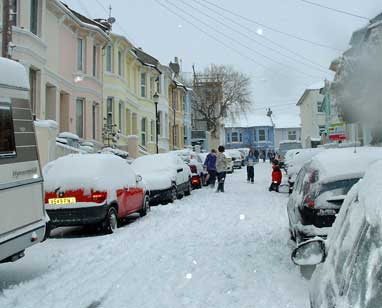
When the houses were built
1880 1-9 Ashdown Road.
1880 2-12 Ashdown Road.
1883 11 & 13 Ashdown Road.
1929 2 Ashdown Road: 10 garages 11 stores
General Comments
Short terraces of 1880s terraced housing of two or three storeys.
History
Ashdown Road is not shown in the Conservative Land Society’s masterplan.
In 1881 properties on Ashdown Road were renumbered.
Streetscape
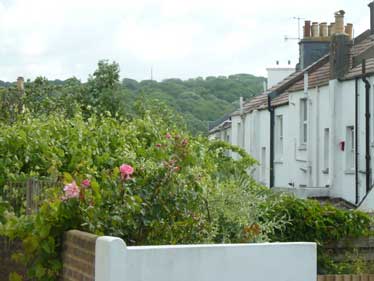
The open flank garden boundary walls allow views towards rear garden trees.
Negative features in the street include the dominant telephone wires.
Views
A view from the junction with Richmond Road east towards the terraced slopes of Hanover and the ridge.
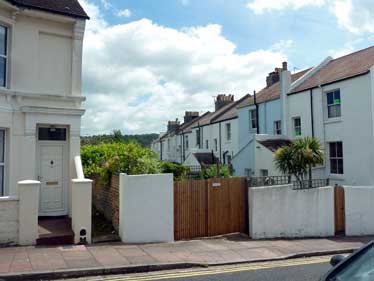
A view through the gap between the terraces (just beyond 12 Ashdown Road to 81 Roundhill Crescent) across the rear gardens of Roundhill Crescent to wooded cemetery land on the east side of the Lewes Road valley.
(L1) 1-13 (odd) Ashdown Road west side
1-9 (odd) were built by McKellow & Cook / German in 1880
11 and 13 were built by Stenning and Denman in 1883. W.A. & J Stenning were builders employing 42 men and 5 boys (1881). Samuel Denman was an architect and surveyor.
The western side of the street comprises a terrace seven houses with stucco facades. These houses descend in height from north to south with entrance to each house is reached by ascending a set of steps.
Nos. 1-13 exhibit a strong group value with a common architectural style and details with very minor variations/alterations. Noteworthy architectural details include canted two-storey bay windows with projecting sills on the ground and first floor windows, supported by scroll brackets. However, it should be noted that scroll brackets are missing from some of the houses, particularly from the ground floor sills of Numbers 3, 7, and 11. Additionally, Nos. 1, 7, 9, and 11 have undergone modifications that are not in harmony with the original design, evident in their replacement windows and front doors. On the other hand, Nos. 3, 5, and 13 have preserved their traditional timber box sashes.
Nos. 3 and 5, 7 and 9, and 11 and 13 are matching pairs with their combined doorway entablature/cornice blending seamlessly into a string course or band. Projecting eaves with brackets, along with a projecting corbel at the party wall eaves. Although the roofs have been replaced with concrete tiles, the original corniced chimney stacks and clay pots have survived on Nos. 1, 3, and 5.
The front boundary walls and piers of Nos. 5, 7, and 7 have been reconstructed using blockwork and brick. The remaining houses have retained their original dwarf walls and capped piers. Original cast-iron stair rails survive between Nos. 3 and 5, and 11 and 13. The original chequerboard encaustic tiles and marble/limestone stair nosings survive to No.1.
The first-floor windows of Nos 1 to 9 are "blind," lacking openings. It seems that Nos. 11 and 13 have been infilled and given a smooth rendered finish.
(L2) 2-12 (even) Ashdown Road east side
2-12 (even) were built by McKellow & Cook / German in 1880.
The eastern side of the street comprises a terrace seven houses with stucco facades. These houses descend in height from north to south with entrance to each house is reached by ascending a set of steps.
Nos. 1-13 exhibit a strong group value with a common architectural style and details with very minor variations/alterations. The style differs from the west side of the street.
Noteworthy architectural details include canted two-storey bay windows with projecting, bracketed sills on the ground and first floor windows, supported by scroll brackets. Window openings are curved at the corners rather than flat arched.
Nos. 4 and 6 and 8 and 10 are matching handed pairs with their combined projecting corbelled doorway entablature/cornice blending seamlessly into a string course. Projecting eaves with brackets, along with a projecting corbel at the party wall eaves.
Nos. 4, 6 and 10 have undergone modifications that are not in harmony with the original design, evident in their replacement windows. The uPVC windows to No. 10 diverge greatly with ill-proportioned top-hung casements with diamond leaded lights. No. 12 has replacement Upvc windows that more closely match the originals. Some front doors have been replaced with less sympathetic designs.
Although the roofs have been replaced with concrete tiles, the original corniced chimney stacks and clay pots have survived on Nos. 6 to 8 and 10 to 12. Some front boundary walls have been reconstructed using blockwork, although all the original capped piers survive.
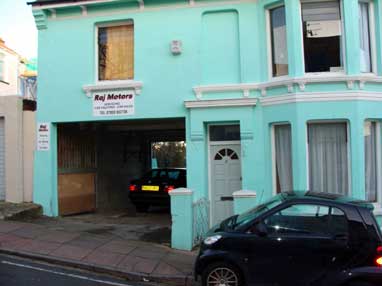
No.2 has a wider frontage with original carriage entrance passing through the building. The original timber gates appear to have been lost and replaced with less sympathetic metal gates. The first-floor secondary windows are “blind, with bracketed sills.”
To the rear of the building, 10 garages and 11 stores were built by Goddard, H / Crouch, A in 1929. In 2010, planning permission was granted for the garages to be demolished and replaced by two new dwellings. The permission included converting 2 Ashdown Road into three flats. This soon followed, but permission for the two new dwellings was sold on and they were built in 2013.
A single garage remained located at the front to the north of the property. Permission was granted for this remaining garage to be converted into an office workshop in 2021.
Occupations
The 1891 census indicates that there was a telegraph linesman, a post office sorting clerk, a laundry superintendent, a laundress and laundry carrier, a coach trimmer, a railway works trimmer, a draper’s manager, two dressmakers, a sign writer, a bricklayer, a plasterer and a gas fitter. The occupation of the 24 year-old resident at no. 5 is given as a Clerk House Agent, yet he (Sam Mussabini 1867-1927) was to become famous as a professional athletics coach. He appears in the film Chariots of Fire.
The blue links (door numbers) link to the 1891 census records and will allow you to find out the names of all the household occupants:
| Richmond Road | Richmond Road | |||
| gardens & wall | vista | office / workshop | ||
| 1 Telegraph Linesman | 2 Laundry Carrier | |||
| 3 Sorting Clerk P.O. | 4 Coach Trimmer | |||
| 5 Clerk House Agent | 6 Post Office Telegraphist | |||
| 7 Sign Writer | 8 Bricklayer | |||
| 9 Trimmer railway works | 8 Dressmaker | |||
| 11 Plasterer | 10 Laundryman | |||
| 13 Gas Fitter | 12 Laundry Superintendant | |||
| rear gardens | vista | rear gardens | ||
| Roundhill Crescent | Roundhill Crescent |
Practise using the Census data site e.g. study of Ashdown Road
- At http://www.freecen.org.uk complete these fields ONLY:
- Surname: Mussabini
- First name: S
- Census County: Sussex
- Census Place: Brighton
- Census Year: 1891
- Click the SEARCH button
- Select for all the information
- Continue viewing data for more households in the same street (or one nearby) by clicking the or buttons
You will gather data on everybody living in Ashdown Road in 1891, including servants.
A known resident is S MUSSABINI of 5 Ashdown Rd (born in Kent)
See https://en.wikipedia.org/wiki/Sam_Mussabini.
Another is William STRAUGHAN of 4 Ashdown Rd (born in London)
Another is Henry Edwin DAPP of 3 Ashdown Rd (born in Sussex)
The lets you fill in the street name. Take care to shorten "Ashdown Road" to "Ashdown Rd". The birth county is optional.
Community
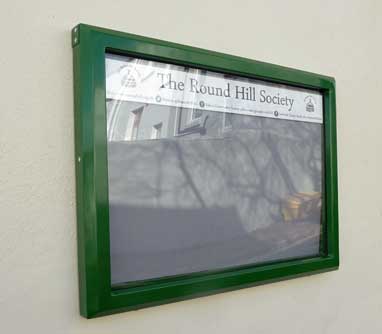
Attached to the wall on the west side of Ashdown Road is one of two Round Hill Society public noticeboards. The Round Hill Society (the local residents’ association) was formed in 1999 and holds an annual get-together open to all Round Hill residents as well as organising local events such as street parties, street play, local history trails, clean-ups, open gardens, advent window calendars and carol singing. Residents are kept informed of issues affecting the neighbourhood through a quarterly newsletter (The Round Hill Reporter) and the website at http://www.roundhill.org.uk
Resources which may help
Check the Ashdown Road plots on the 1897 Map on the National Library of Scotland's website.
- The gaps between the terraces at the four corners of Ashdown Road continuing the green vistas provided by the rear gardens of properties in Richmond Road and Roundhill Crescent.
- The first plot on the E side is an outbuilding (later a garage).
Then comes no. 2 Ashdown Road, which includes an underpass.
Round Hill history texts
Ashdown Road | Belton Road | Crescent Road | D'Aubigny Road | Ditchling Road | Lennox Passage (The Cats Creep) | Mayo Road | Princes Crescent | Princes Road | Richmond Road | Round Hill Crescent | Round Hill Road | Round Hill Street | Wakefield Road