D'Aubigny Road
After reading this page, try the 19-question quiz
1881 Properties in D’Aubigny Road were renumbered.
1933 Lewes Road passenger railway station closed to passengers.
Buildings were converted into the Victor Sauce and Pickle factory, with the forecourt reverting to a coal yard.
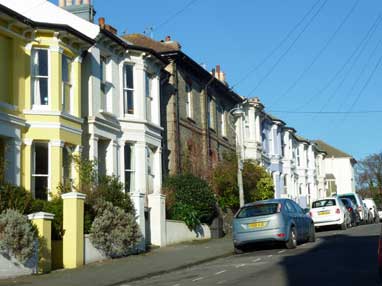
D'Aubigny Road comprises short terraces of 1880s terraced housing of two or three storeys. Negative features in the street include the dominant telephone wires and some of the replacement front doors, such as those at nos. 11, 13 15 and 17.
Renumbered 20 April 1881
The former Lewes Road Station stood on the corner with Richmond Road.
History
D’Aubigny Rd is a short, fairly steep road with houses on both sides, which runs from the north east end of Roundhill Crescent to join Richmond Rd.
What is the origin of the unusual name of ‘D’Aubigny’?
Suzanne Hinton’s research (see www.suzannehinton.uk) shows it to be named after the 5th Duke of Richmond, Charles Gordon Lennox (1791-1860) who also happened to be Duke of D’Aubigny, a dukedom in the peerage of France. This seems the most likely explanation as the original plan of the Round Hill Estate had a symmetrical road to D’Aubigny Rd running between Round Hill Crescent to the south end of Richmond Rd which was to be named Lennox Rd. These two roads were joined by Richmond Rd. Lennox Rd was never built as the terrain was deemed too steep. A steep stepped foot passageway was created instead and named Lennox Passage. This name fell into disuse and the passageway is now called The Cats Creep.
Most of the houses in D'Aubigny Road date from circa 1878.
In the 1871 population census, only a lodging house (Viaduct House) is listed in D'Aubigny Road run by James Fuller, a 58-year-old gardener and his 55-year-old wife, Caroline Fuller. The boarders are Samual Saunders 22 and Joseph Saunders 20 (both labourers from Poole Dorset) and Samual Gregory 24 (a labourer from Hampshire). Note that the street directory for 1871 lists no houses present. It is possible that Viaduct House was used as a base while Lewes Road Station - first stop on the Kemp Town branch line - was being constructed. The Kemp Town branch line was opened by Brighton and South Coast Railway on Monday 2nd August 1869 to stop rival companies reaching Brighton via Kemp Town.
Lewes Road Station on top of the viaduct at the junction of Richmond Road and D'Aubigny Road was on land which is now part of The Centenary Industrial Estate. It was added to the Kemp Town branch line in 1873 - and actually constructed before London Road Brighton station came into existence on the Brighton to Lewes line.
Setting & Views
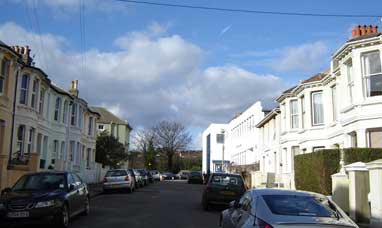
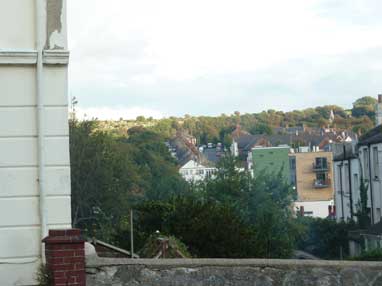
D’Aubigny Rd rises steeply to the north from the north east RoundHill Crescent. It benefits from long tree framed views looking south over houses & the Lewes Rd valley up towards Race Hill and long views from the street eastwards over the bungaroosh wall & gardens of 4 D’Aubigny Rd & 101 Round Hill Crescent towards the Downs at the top of Race Hill. These views have been partly obstructed by the intrusive high side elevation of Sainsburys. At D’Aubigny Rd’s highest point, its junction with Richmond Rd, the aspect opens north-eastwards looking over and above the Industrial estate. This aspect is tree lined giving a welcome green openness to the street where front gardens are all very small and mostly concreted over. Running down the green slope at this junction, down the side of Richmond House to Hughes/Hollingdean Rds is ‘spiny ridge’ an informal footpath much used by local school children for over 40 years as a short cut to local secondary schools (Dorothy Stringer & Varndean).
Street Furniture
The original brick paver footpaths are now sadly tarmaced over, but two original Victorian lampposts do remain. Many more can be found across Round Hill. Originally designed for gas, these were later adapted to work with electricity. The lamp post at the north end of D’Aubigny Rd is one of the oldest and rarest in Brighton. Probably cast in the 1850s by Palmers of Brighton (iron founders in the North Laine). The horizontal bar near the top was to provide a rest for the ladder which was needed to turn the gas on & off. Mains electricity was laid in Brighton in the 1890s, after which the BLEECO boxes were added (Brighton Lighting and Electrical Company) together with swan neck lamps replaced the original gas lamps.
No. 9 still has a boot scraper set into one of its entrance pillars and nos. 11 & 5 still have empty holes which once held their boot-scrapers. All of the houses have lost their original cast iron fences, which were (misguidedly) collected during the war to use the metal for making ammunitions. Rail fixings can still be seen on the entrance pillars of number 12.
West Side 1-17 (odd) west side
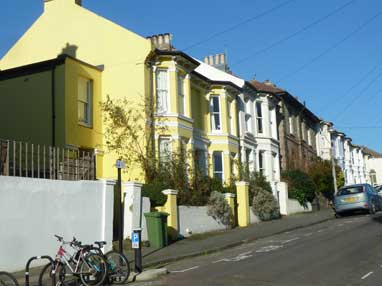
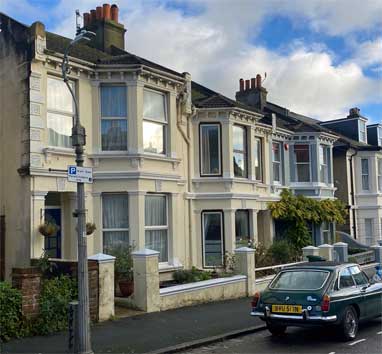
On the west side there is a mix of symmetrical pairs of smaller houses whose rhythm is bay-door-door-bay, apart from Nos. 1, 3 and 5.
No. 1 is a double-bayed house with a central door with a rhythm of bay-door-bay, built by Towner and Denham in 1878.
No. 3 is a single bay house whose rhythm is door-bay (from left to right), built by Towner in 1879.
No. 5 D'Aubigny Road is the oldest house in the street.
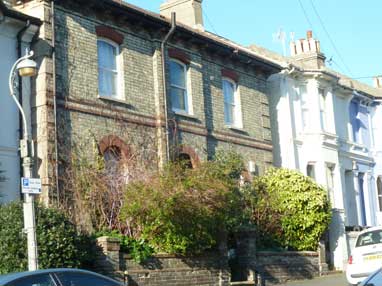
Its exact date of construction is unknown. It is an unusual buff coloured double fronted house with a red brick string course to the first floor and red brick arches to the windows and recessed front porch. It has cambered/segmental arches to the first floor. Bracketed eaves in brickwork. Brick quoins travel around the flank elevation pointing to the original detached house form -now conjoined with adjacent terraces.
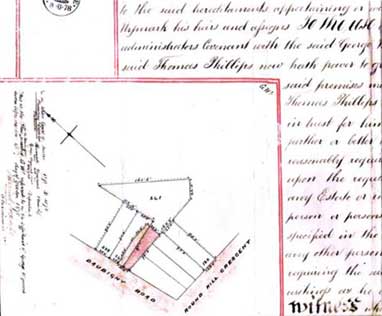
It was possibly developed by the owners of Brighton and Sussex Laundry Works (93 Lewes Road site of Sainsbury’s). A footpath ran between D’Aubigny Road along the north garden boundary of 101 Roundhill Crescent to the laundry.
No. 17 is known to have been built by Towner and Denman in 1878.
East Side (4 to 12)
On the east side there is a mix of houses whose rhythm is door-bay-bay- door and bay-door-door-bay and larger double-bayed houses whose rhythm is bay-door-bay
D'Aubigny Road has two-storey houses and a significant amount of uniformity. The houses are mostly painted in different shades of cream or white. Nearly all the houses have bracketed eaves, excluding Nos. 6, 6A and 16, and most have lost their original slates being replaced by corrugated concrete tiles. With the exception of Nos. 5 and 14, all the houses have two-storey canted bays. Except for no. 5, which has gault brick walls and pillars with red bands, all the houses are of stucco. They have rich mouldings with bracketed and moulded cills, moulded storey bands, and entrance surrounds consisting of pilasters with Tuscan capitals, flat arches and entablatures. Nos. 4 and 6 & 6A have rusticated bandings on their ground floor elevations. Almost all the houses do not have rooflights or dormer windows on their front elevations, except for no. 15 where a rooflight is present, and No 6 & 6A where there are three dormer windows. The latter are not symmetrically placed and are not original.
The front boundaries of the houses are marked by rendered walls which are low in height with gate pilasters with moulded caps, apart from nos. 4 and 5. The boundary wall of No 4, a late Victorian or early Edwardian alteration, is of red brick with flint panels.
No. 4 adjoins the north end of plot of 101 Roundhill Crescent. There has never been a number 2 on the east side.
No. 4 is D'AUBIGNÉ VILLA a single bay house built in July 1878 by Wymark and Pike for George and Jane Wymark. George was a successful tea merchant.
No. 6 & 6A differs in style except for the rustication bandings on the ground floor. It is unusual in that it has a side extension with a segmental curved archway, although this has been blocked up crudely and unsympathetically. This archway probably led through to a stable at the rear originally.
No. 6 was home to Perhaps the most famous residents of D’Aubigny Rd were the family of Arthur H Cox (1813-1903) who was a local successful chemist.
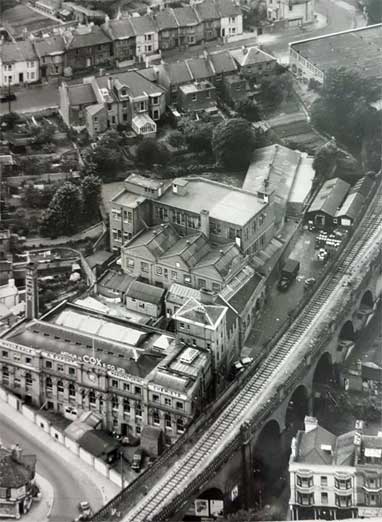
The picture below shows Richmond House built by Mr Tony & Mrs Roy Cox (foundation stone 1957) after Lewes Road Railway Station was demolished. This was used as a packaging department for Cox’s Pills. The Cox family were still living further down D’Aubigny Road at number 6/6a.
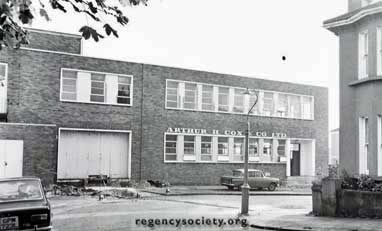
No. 6 was then a large double fronted house with an arched carriageway on one side (now filled in) leading into the extensive garden which included tennis courts and a taxidermy studio. The gardens opened into the rear of Coxs Pill Factory on Lewes Rd ( formally a laundry works). Arthur H Cox established his first chemist in 1839 in Ship St Brighton, moving to Lewes Rd in 1910. The company patented sugar coated pills in 1854 and were highly successful. It is thought the family moved to no. 6 in 1930, which they leased for £85 per year. Company annuals tell of regular works outings and tennis parties in the garden.
Arthur H Cox was a Brighton Mayor on three occasions and is buried in Woodvale Cemetery. His son/grandson Tony Cox built Richmond House in 1950(?) on the site of the demolished Lewes Rd garage as a packaging department for Cox’s. The company moved to Devon in 1979 and the factory was demolished in 1983. Sainsburys was built on the site in 1984.
Nos 8, 10 and 12 were built by Towner in 1894 and are similar in style.
Nos. 8 & 10 have original door (& 8 leaded doorlights) Both retain original tiled pathways.The rare lamp post can be seen outside no. 12.
No. 14 was built in 1895 for the then Lewes Road Stationmaster by The London, Brighton & South Coast Railway.
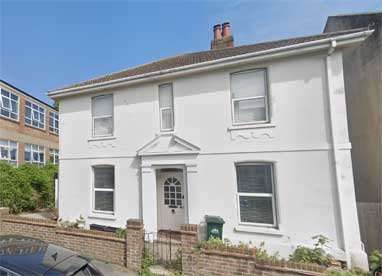
There had been other stationmasters before since the Kemp Town branch line was opened on 2nd August 1869. The passenger service was withdrawn on 1st January 1933, though surprisingly the goods service survived until 1971.
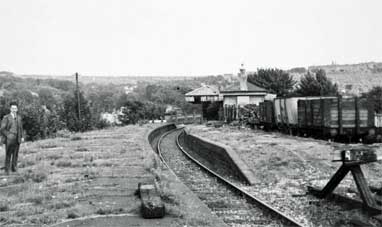
Lewes Rd Station (www.disused-stations.org.uk)
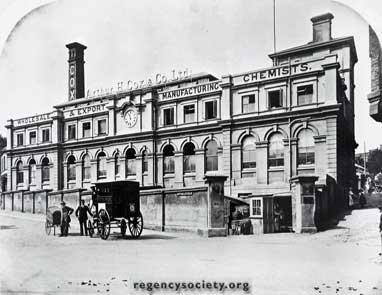
The station was built on the site now occupied by Richmond House. The rail track diverged from the Brighton-Lewes railway line just east of Ditchling Rd tunnel and curved southwards along an embankment to the station, it then passed over a fourteen arch viaduct over the Lewes Rd, across a three arch viaduct over Hartington Rd, through a cutting the green area now known as The Patch into a tunnel under Elm Grove School & Race Hill to Kemptown. The station consisted of an island platform and second platform with railway buildings with a covered flight of steps down to the Lewes Rd. Closed to passengers in 1933 and to freight in 1971.
After the station was closed it was used as a pickle factory before being demolished in the 1950s. The short viaduct over Hartington Rd was demolished in 1973 and part of the longer viaduct in 1976. The last section was demolished in 1983 to enable the building of the Vogue Gyratory.
Either side of D’Aubigny Road (unspecified)
1 house built by D. Jackson in 1868
1 house built by Phillips and Denman in 1879
When the houses were built
1868 D'Aubigny Road 1 house
1878 4 D'Aubigny Road
1878 1 and 1a D'Aubigny Road
1878 17 D'Aubigny Road
1879 D'Aubigny Road 1 house
1879 3 D'Aubigny Road
1894 8, 10 & 12 D'Aubigny Road
1895 14 D'Aubigny Road station master's house London Brighton & South Coast Railway
Most of the houses in D'Aubigny Road date from circa 1878.
In the 1871 population census, only a lodging house (Viaduct House) is listed in D'Aubigny Road run by James Fuller, a 58-year-old gardener and his 55-year-old wife, Caroline Fuller. The boarders are Samual Saunders 22 and Joseph Saunders 20 (both labourers from Poole Dorset) and Samual Gregory 24 (a labourer from Hampshire).
In spite of the above, The street directory for 1871 lists no houses present. It is possible that Viaduct House was used as a base while Lewes Road Station - first stop on the Kemp Town branch line - was being constructed. The Kemp Town branch line was opened by Brighton and South Coast Railway on Monday 2nd August 1869 to stop rival companies reaching Brighton via Kemp Town.
Lewes Road Station on top of the viaduct at the junction of Richmond Road and D'Aubigny Road was on land which is now part of The Centenary Industrial Estate. It was added to the Kemp Town branch line in 1873 - and actually constructed before London Road Brighton station came into existence on the Brighton to Lewes line.
Early Station Masters at Lewes Road railway station
Local street directories record Mr Anguille as living at Lewes Road railway station in 1874 and 1875 and Mr William Burtenshaw as living there in 1878.
See also Where the name "D'Aubigny" comes from
Occupations 1891 Census
| House | Occupant | Age | Occupation |
| 1 | James TOWNER | 61 | Builder |
| 1 | Jane TOWNER | 61 | wife |
| 3 | James DOVELL | 70 | Retired Building Surveyor |
| 4 | George WYMARK | 74 | Retired Tea Dealer |
| 4 | Jane WYMARK | 72 | Wife |
| 5 | Thomas BEALE | 66 | Corn Merchant |
| 5 | Ruth BEALE | 53 | Wife |
| 6 | William EVERETT | 45 | Retail Hatter |
| 6 | Mary EVERETT | 59 | Wife |
| 6 | Mary GOLDSWORTHY | 18 | (Stepdaughter) Perfumer |
| 7 | William DEVAL | 62 | Deputy Custodian Planter |
| 7 | Amy DEVAL | 56 | private means |
| 7 | Emily DEVAL | 59 | private means |
| 7 | Sophia DEVAL | 52 | sister |
| 9 | Charles MERCER | 61 | Insurance Agent |
| 9 | Ann MERCER | 66 | wife |
| 9 | Elizabeth MERCER | 21 | General Sevant |
| 11 | Thomas BARBER | 29 | Railway Clerk |
| 11 | Sophia BARBER | 31 | wife |
| 13 | James MANTELL | 30 | Postal Stamper |
| 13 | Maria MANTELL | 30 | Wife |
| 15 | Alfred FREEMAN | 60 | Railway Porter |
| 15 | Elizabeth FREEMAN | 61 | Wife |
What else is known about the above people?
Also living at No.4 is Maggie CAMERON (aged 14) a domestic servant. Twenty years earlier, George and Jane Wymark are shown living at 59 Western Road Brighton with a 16-year-old daughter, Catherine, and an 18 year-old general servant called Elizabeth SCRACE. George's occupation in 1871 is given as "Milliner".
Also living at No. 6 is Emma WINDEAT (aged 56) sister to Mary EVERETT and two (WINDEAT) daughters as well as Fanny TURNER (aged 20) general servant.
At No 11, the young couple have two very young children - Stanley (aged 3) and Nora (aged 1) BARBER. They also have a lodger John HARYETT (aged 30) an Engine Fitter.
4. In July 1878, Wymark and Pike build No.4 (George and Jane Wymark's house D'AUBIGNÉ VILLA) at the south east end of the street.
1. James and Jane Towner are listed in the 1871 population census, as both aged 41 and resident at 14 Lewes Road. James is already a builder.
In Nov 1878, Towner and Denman build No.17 - a small house at the north end. In Dec 1878, they also build No.1 (Towner's own house) at the south west end. In March 1879, Towner builds No. 3 at the south-west end of the street.
Click here to return to history research links
Round Hill history texts
Ashdown Road | Belton Road | Crescent Road | D'Aubigny Road | Ditchling Road | Lennox Passage (The Cats Creep) | Mayo Road | Princes Crescent | Princes Road | Richmond Road | Round Hill Crescent | Round Hill Road | Round Hill Street | Wakefield Road