Princes Crescent
After reading this page, try the Princes Crescent quiz
See also the Princes Crescent section on pages 32-35 of the proposed update for Round Hill's conservation character statement:
General Comments
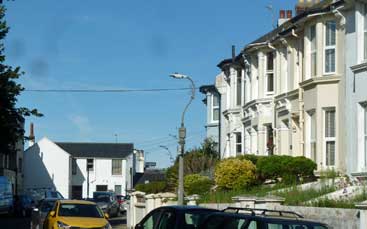
Prince's Crescent forms a steeply curved road which runs along the contour from east to west. To the south, and outside the conservation area, are the blocks of modern flats, the Sylvan Hall Estate, named after the group of large, detached mansions they replaced, which contribute to the setting of the conservation area because of their trees. Opposite the end of Wakefield Road is one three storied pair, with two storied canted bay and flat porches with corbels. Many of these houses have modern rooflights, concrete roof tiles, and replacement windows and doors.
Streetscape
1-11 (odd) Prince’s Crescent (north side)
Houses 1 to 7 are some of the earliest in the street, built by Fellingham in 1878.
Nos. 9 and 11 were built as 2 shops by Gurr / Denman in 1879. The 1891 census has the 28-year-old Frederick Spyer as a general shop keeper running a green grocer and a dairy at No.9. He is assisted in this by Evelyn Olme his 21-year-old servant.
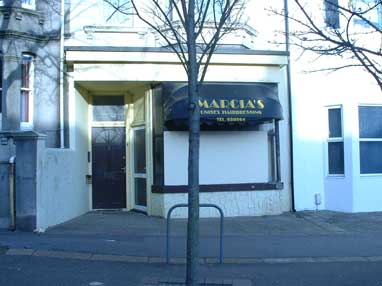
More recently, 9 Princes Crescent was first Jenning’s Ladies Hairdresser and later Marcia’s Unisex Hairdresser. It was converted to a residential property in 2008
13-29 (odd) Prince’s Crescent (north side)
To the north, and up steps with small front gardens, are two storied terraced houses with slightly more ornamentation than some of the other houses within the conservation area of a similar date including channelled stucco to the ground floor and paired brackets to the eaves.
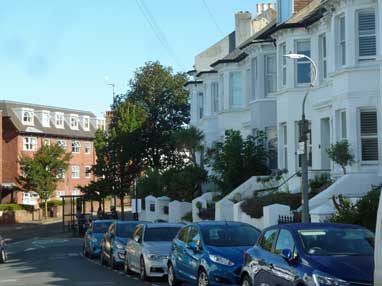
Nos. 27 to 43 (up to the junction with Belton Road) date from 1881 and were built by Edwards and Denham.
31-43(odd) Prince’s Crescent (north side)
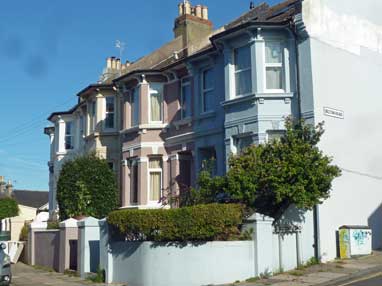
45-49 (odd) Prince’s Crescent (north side)
51-69 (odd) Prince’s Crescent (north side)
The five houses from 45-53 date from 1882 and were built by Greedy & Fearce / Bradfield. Nos 55 & 57 date from 1881 and were built by Comber. No. 59 was built by Bradfield / Denman in 1881, no. 61 by Norrish / Bradford in 1881 and nos. 63-69 (up to the junction with Crescent Road) by Bradfield on 1882
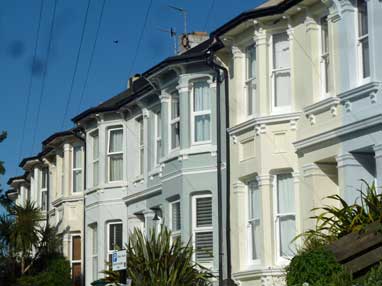
69- 93 (odd) Prince’s Crescent (north side)
The houses in this section referenced by East Sussex Record Office are nos. 81 and 83 built in 1878 by Child / Loader, no. 85 built in 1924 by Lovick / Sanders and no. 87 built in 1896 by Coles. Nos. 89, 91 & 93 first appear on the electoral register in 1908. Their uniformity suggests that they were the work of the same builder. Note that a plot was vacant for these houses since the semi-detached villas once contemplated for nos. 1 & 3 Richmond Road were never built.
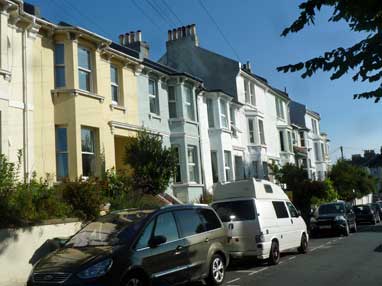
Prior to the demolition to make way for the present Sylvan Hall Estate, these houses would have had a good view of Wakefield Villa (demolished in 1951) located in the apex land between Princes Crescent and Wakefield Road roughly where the 3-storey block of flats named The Chestnuts sits today. The three other Rose Hill villas were located south of what is now Bromley Road so they would have been more distant and probably obscured by woodland.
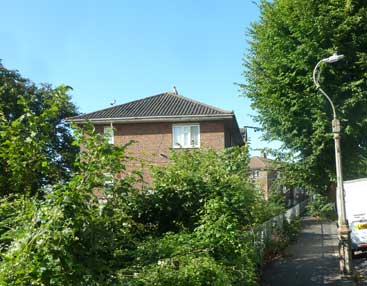
Though outside the boundary of the conservation area, buildings now on the south side of Princes Crescent (from east to west) are The Chestnuts, The Willows, The Poplars and Crescent Mansions. There is a further house called Downs View just past Crescent Mansions, which falls within the Round Hill conservation area.
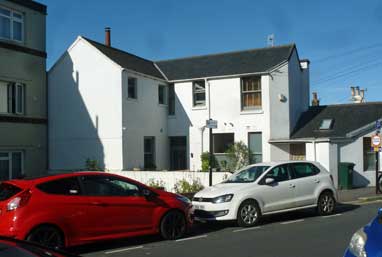
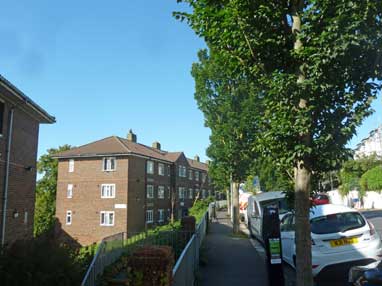
The southern pavement of Princes Crescent falls within the setting of the conservation area. The poplar trees planted at regular intervals soften the appearance of the 1950s blocks of flats (appropriately named).
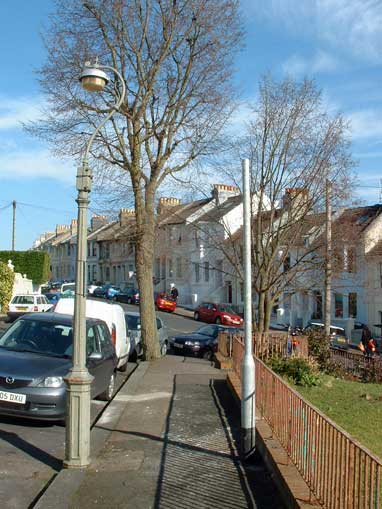
At the eastern end of the southern pavement, there remains one of Round Hill’s historic street light columns dating back to the 1880s. In 2008, there was an attempt to replace it with a steel pole, which was even installed, but local residents were quickly onto the case and the steel pole was removed.
Occupations
The 1891 census shows that early residents were predominately working class. As with most Round Hill streets, several of the occupations are railway-related: signalman, locomotive engine driver, carriage maker, railway clerk, porter, pullman car conductor, shoeing smith for the London, Brighton and South Coast Railway.
In the wake of the 1880 Education Act making school attendance compulsory for children between the ages of 5 and 10, there was a growing number of teachers: two elementary teachers, an art class teacher, a professor of music, a chemistry teacher and a pupil teacher (aged 18).
A notable occupant was the artist Arthur Willett living at 81 Princes Crescent, who painted in oil and water colour. He was aged 34 at the time of the 1891 census. His date of birth corresponds with that of a famous artist of the same name who lived in Brighton, but the latter emigrated to America in 1888 and did not share the same place of birth. Round Hill’s Arthur Willett had five daughters aged between 8 and 1. Although they were born in Chelsea, Ashford and Horsham, he is unlikely to have been as mobile as his namesake.
The 1911 census still has a greengrocer’s shop at no. 9 and a butcher’s at no. 11. Unlike Richmond Road, there is not a single laundress in Princes Crescent and no more than a couple of dressmakers. Railway related jobs are still present, though there are now two residents working as tramway conductors. Clerical work is much in evidence in the fields of law, accounts, newspapers, stationery as well as railways. As in Richmond Road, jobs related to electricity (electrical contractor, electrical engineer) are making an appearance, but few women are in occupations. The exceptions are waitress, cigarette maker, bookkeeper, cashier, shorthand typist and the job of 33-year-old Edith Terry living at no. 45. She is described as an “Engineer and Cinematographer’s Manufacturer”.
The south west side of Princes Crescent is bounded by Downs View, Crescent Mansions, The Poplars 1-6, The Willows 1-12, and The Chestnuts 1 - 6. The buildings named after trees belong to Sylvan Hall, a 1950s development of flats.
Dates of houses on the north east side
1878 1-7 Princes Crescent.
1878 81 & 83 Princes Crescent.
1879 9 & 11 Princes Crescent. 2 shops.
1881 27-29 Princes Crescent.
1881 31 Princes Crescent.
1881 33 Princes Crescent.
1881 35 - 43 Princes Crescent.
1881 45 - 53 Princes Crescent.
1881 55 - 57 Princes Crescent.
1881 59 Princes Crescent.
1881 61 Princes Crescent.
1882 63 - 69 Princes Crescent.
1896 87 Princes Crescent.
1924 85 Princes Crescent.
Nos. 89, 91 & 93 first appear on the electoral register in 1908.
Round Hill history texts
Ashdown Road | Belton Road | Crescent Road | D'Aubigny Road | Ditchling Road | Lennox Passage (The Cats Creep) | Mayo Road | Princes Crescent | Princes Road | Richmond Road | Round Hill Crescent | Round Hill Road | Round Hill Street | Wakefield Road