Lamp Posts
from The Round Hill Reporter October 2013.
Love your lampposts
When the houses and roads of Round Hill were being built from mid-19th to early 20th centuries, the street lights that were installed all ran on coal-gas. The gas was initially made at Black Rock by the Brighton Gas, Light and Coke Company, established just outside the parish of Brighton to avoid coal-tax. One of the Victorian gas holders still stands there, behind a high flint wall on Boundary Road. I have heard it said that the name Black Rock came from the discolouring effect of hauling coal up the cliff from ships on the beach to the gas works.
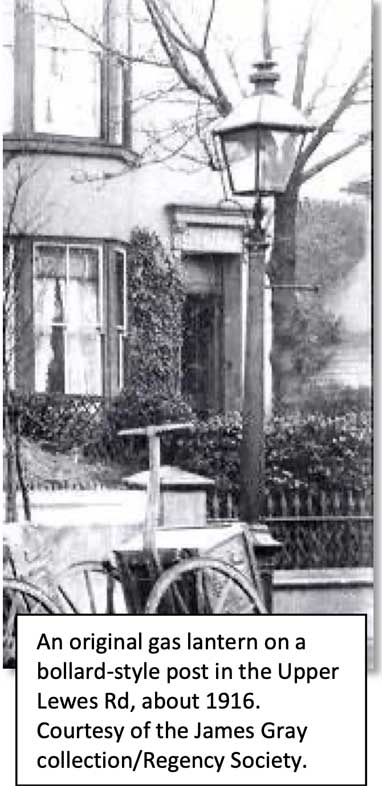
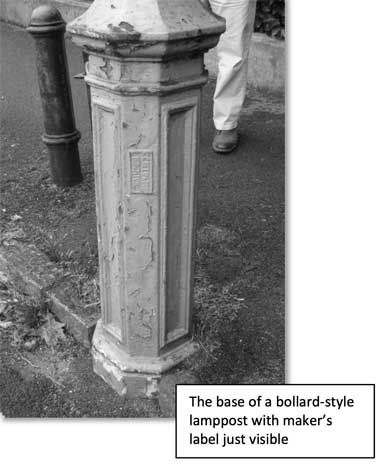
We still have 19 of the originally installed lampposts on our streets. They are cast-iron and have an octagonal lower section that was probably first designed as a bollard. The local iron foundry would have adapted their bollard pattern to make a lamp-post. A projecting arm near the top of the post would accept a ladder for maintaining, repairing and lighting the gas lamp. The name 'C G Reed and Son' appears on a bollard lamppost at the junction of Princes and Mayo Roads – this business traded in that name from 1878 to 1912, from 26 North Street, as ironmongers and ironfounders.
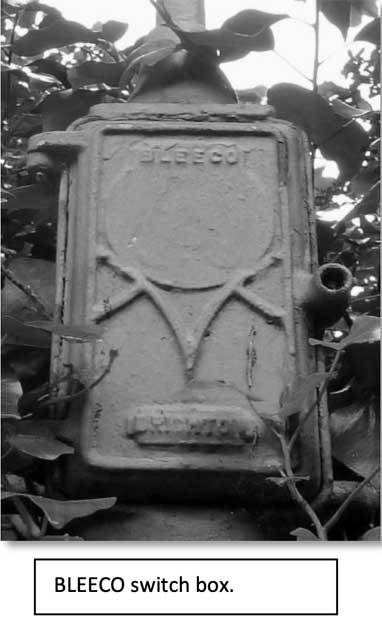
Originally the lamplight would be yellow, from a flickering gas flame, but the invention of the gas mantle in 1891 gave a brighter, whiter light. The gas mantle is used today in camping lanterns running on bottled gas. Metal oxides in the fine mesh mantle glow with a brilliant white light when heated. The Brighton Lighting and Electrical Engineering Co (BLEECO) was established in 1921 in St Martin's Place to make kit for converting gas lights to electric street lighting. Many of the Round Hill cast iron lampposts have BLEECO electrical switch boxes and swan neck electric light supports fitted to them. BLEECO also installed new cast iron posts for electric lights which have switch controls behind a door at the bottom of the post. We have examples made by ironfounders John Every of Lewes in Belton Rd and Wakefield Rd. Every may also have cast the BLEECO badged posts in Wakefield Rd, and Princes and Round Hill Crescents. The most recent cast iron post is outside 64 Crescent Road. It was ordered by the Council just before the Wolverhampton company of Edwin Preston ceased trading in 1981.
Our three oldest lampposts were probably erected to replace damaged bollard-style posts – two (east end Round Hill Crescent and east side Belton Rd) are Beehive-style lampposts made for Hove Council during the 19th century, and perhaps the oldest, near 12 D'Aubigny Rd, is in the form of a simple classical column.
Rob Stephenson
See Thematic survey of Street Lights
1. In The Dark Round Hill Reporter (Dec 2008)
2. Lamp Post Quiz interactive version (with answers)
3. Street lamps correspondence
How many emails does it take to save a lamp?
4. Save Our Swan-neck heads
5. Street Lamps
This page was last updated by Ted on 16-Apr-2026